What's Inside
- What Is the New Era of Digital Autobiographies?
- How Did We Move From Manual Journals to Passive Data?
- Why Is Context-Aware Technology Crucial for Lifelogging?
- What Are the Limitations of Quantifying Every Moment?
- Where Is the Quantified Self Movement Heading Next?
What Is the New Era of Digital Autobiographies?
A digital autobiography is no longer something we sit down to write after the fact. It is increasingly something we assemble while life is happening: heart-rate summaries, sleep intervals, movement traces, calendar records, meal notes, location history, and the small signals that collect in the background while we are busy living.
From memory to trace evidence
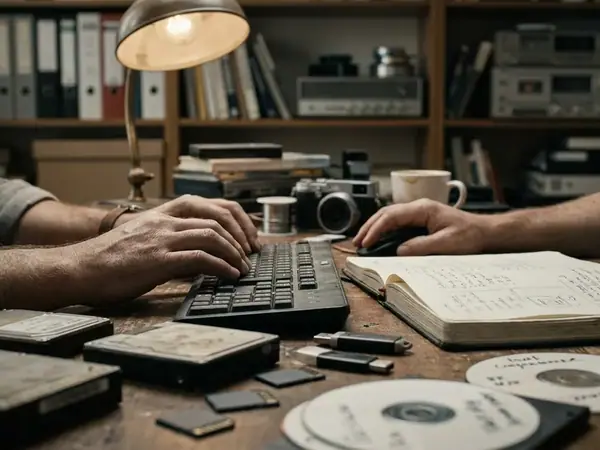
Traditional autobiography depends on recall. That is not a flaw; memory gives shape, emphasis, and emotional meaning. But memory also edits. It forgets the dull Tuesday commute, the late caffeine, the unusually warm bedroom, the restless stretch before sleep, and the small training decision that changed the next morning’s recovery.
Modern lifelogging changes the capture timing. Instead of asking, “What do I remember about that week?” we can ask, “What traces did the week leave behind?” A current lifelog can combine minute-level heart-rate summaries, step counts accumulated through the day, sleep intervals scored in roughly 30-second epochs by many sleep-analysis systems, and location points captured at intervals ranging from about 1 to 15 minutes depending on device settings.
That difference matters. The record is not inherently wiser, but it is closer to the event.
Main Point: The modern digital autobiography is less like a memoir draft and more like a longitudinal evidence file that still needs human interpretation.
The quantified self becomes narrative material
The quantified self movement gave people a language for treating everyday life as measurable. Steps, sleep, heart rate, fasting windows, caffeine timing, cold exposure, and training load became personal variables rather than vague impressions. A person who once wrote “felt sluggish today” might now notice that the entry followed a short sleep interval, a late meal, and a harder-than-usual run.
Biohacking adds the intervention layer. Caffeine timing, fasting windows of 12 to 20 hours, cold exposure sessions of 2 to 10 minutes, and training load after runs or strength sessions become part of the autobiography rather than side notes in a separate tracker.
I find this most useful when the data is treated as a prompt, not a verdict. The record can say, “Something changed here.” It cannot always say what that change meant.
How Did We Move From Manual Journals to Passive Data?
The history is mostly a story about friction. Manual journals ask for discipline at exactly the wrong moment: during the meal, after the workout, before bed, or while the user is already tired.
The manual era had a timing problem
Manual tracking usually requires an explicit action at the moment of the event or within the same evening. Miss even a handful of entries in a week, and nutrition, mood, or activity logs can become too patchy for useful pattern-finding. The missing data is rarely random, either. People skip entries when they are busy, stressed, traveling, embarrassed, or bored.
That creates a practical bias. The most chaotic days are often the least documented days.
Early lifelogging experiments tried to solve this by making capture less dependent on intention. Microsoft Research’s MyLifeBits project explored whether a person’s day could be searched later by time, place, object, or social context. Early prototypes used wearable cameras, desktop activity logs, calendar metadata, and location traces. The ambition was not just storage. It was retrieval.
What passive logging actually does
Passive logging works because phones and wearables now carry the sensing burden. Accelerometers sample in the tens of hertz. Optical heart sensors switch between low-power background readings and more frequent workout readings. Phone operating-system activity classifiers label walking, driving, cycling, or stillness without asking the user to tap a button.
The operational change has become visible over the past decade. Always-carried phones, rechargeable wearables with battery life ranging from about 1 to 7 days, and cloud sync made continuous capture less intrusive than carrying a separate lifelogging device.
Expert Tip: If you want a usable personal archive, reduce the number of moments that require manual entry. Save deliberate input for the details sensors cannot infer: mood, meaning, pain, motivation, and social context.
A lifelogging application such as Saga sits in this practical territory. The useful question is not whether every signal can be captured. It is whether the captured signals can later help reconstruct a day with enough accuracy to support reflection.
Why Is Context-Aware Technology Crucial for Lifelogging?
Raw biometric data is ambiguous. An elevated heart-rate pattern may represent a workout for a runner, a panic episode for someone at rest, heat strain during a summer commute, or caffeine response after a late espresso. Interpretation changes when motion, location, temperature, and calendar context are added.
The same signal can tell different stories
Consider a heart-rate spike. On its own, it is a fact without a scene. Add motion, and it may become stair climbing. Add GPS route shape and duration, and it may become a run. Add a stationary phone at an office location during a scheduled meeting, and it becomes a different kind of clue.
A context-aware daily summary might merge a 07:10-07:42 run, elevated heart rate, outdoor temperature from a nearby weather feed, GPS route shape, and a post-run resting decline to label the event as training rather than anxiety. The label is still an inference, but it is a better inference than heart rate alone.
Calendar correlation depends on start and end timestamps, location proximity, and device motion. A heart-rate rise during a 14:00-15:00 meeting means something different if the phone was stationary at an office location than if the accelerometer shows stair climbing.
Context turns logs into sequences
A day becomes readable when short segments are stitched together. Commute from 08:05-08:37. Desk block from 09:02-11:48. Lunch walk from 12:16-12:34. Focused work block from 13:10-15:20. Exercise from 18:05-18:51. Sleep onset between 22:40 and 23:15.

That sequence feels simple, but it depends on many quiet inputs. Barometric pressure changes can help with elevation gain. Ambient noise levels can support commute or venue detection. Light exposure can matter for circadian analysis. Temperature and humidity can help interpret sleep disruption.
This is where digital autobiography becomes more than a pile of metrics. The system starts to ask: what was happening around the body when the body changed?
Caution: Context-aware systems should use confidence, not certainty. A device can infer “likely commute” or “possible stressful meeting,” but it cannot know the private meaning of the event without human input.
What Are the Limitations of Quantifying Every Moment?
The limits fall into three layers: portability, privacy, and meaning. They are often discussed together, but they behave differently in practice.
Portability is still uneven
Fragmentation shows up quickly. Sleep history, workout files, glucose logs, calendar entries, voice notes, and location trails may export in different formats such as CSV, JSON, GPX, FIT, image files, or proprietary archives. A person can have years of data and still struggle to make it readable in one place.
This matters for digital autobiography because chronology is fragile. If the sleep record lives in one platform, the workout file in another, the calendar in a third, and the reflective notes somewhere else, the story becomes harder to reconstruct. The archive exists, but it is scattered.
Privacy risk grows with time
A single month of passive life data can include thousands of location points, hundreds of heart-rate summaries, dozens of workouts or mobility segments, multiple sleep sessions, and a dense calendar trail. That combination can reveal home, workplace, medical visits, social routines, and travel habits.

The security risk increases because lifelogging archives are longitudinal. A breach of 18 to 36 months of location and health data exposes routines, not just isolated records.
This is not a reason to reject lifelogging outright. It is a reason to treat personal archives as sensitive records, closer to clinical notes than casual app history.
Metrics do not carry the whole person
Here is the philosophical gap I keep returning to: two days can have similar step counts, sleep duration, and heart-rate averages while one was a restorative holiday and the other was an exhausting day of errands and family stress.
One catch: passive archives are most useful for reconstruction and pattern detection, but they are weak at capturing motives, private meanings, and emotional nuance unless the person adds occasional written, spoken, or photographic reflection.
This is where authors and practitioners such as Kevin Rexroat, Kitty Ireland, and Thursday Bram are useful reference points for me. The best personal records do not worship the metric. They ask what the metric helped the person notice.
Main Point: Quantification can preserve the outline of a life, but the subjective layer still needs a human witness.
Where Is the Quantified Self Movement Heading Next?
The next bottleneck is translation. Much of the data is already being captured; the hard part is turning raw streams into readable daily memory without flattening the person into a dashboard.
AI-generated recaps are the obvious next step
Near-term systems are likely to generate daily recaps from the previous 12 to 24 hours of data, weekly trend summaries across 7-day windows, and longer monthly reviews that compare sleep, activity, mood entries, travel, and work blocks.
Readable summaries can be assembled from event boundaries: sleep episode, first unlock or first movement, commute segment, high-focus block, social appointment, workout, meal photo or nutrition entry, and evening wind-down. The result may look less like a spreadsheet and more like a journal entry drafted by a careful assistant.
The better versions will avoid absolute claims. Machine-generated autobiography will probably use confidence labels such as “likely commute,” “possible stressful meeting,” or “unusual late-night activity,” because many sensor inferences remain probabilistic.
A balanced practice stays partly intentional
The most durable approach may be mixed: let automation capture the scaffolding, then add a small human note where it counts.
That note does not need to be elaborate. Somewhere around thirty to 90 seconds of evening voice reflection, one manually chosen photo, or a short mood tag can give an algorithm enough subjective context to avoid a purely mechanical diary. The point is not to record everything. The point is to preserve the parts that future-you will not be able to infer from heart rate and location alone.
A failure case makes this plain: a person who disables location services, charges a wearable overnight instead of wearing it, and keeps meetings in an unshared calendar will produce a fragmented autobiography where heart-rate and step data lack enough context to explain the day.
Expert Tip: Choose one low-friction reflective habit and keep it close to the end of the day. Automation handles sequence; reflection handles meaning.
Digital autobiographies are changing life recording by moving the first draft out of memory and into continuous capture. That is powerful, but it is not complete. The strongest personal archive will pair passive data with deliberate interpretation, so the record shows not only what happened, but why it mattered.