
Who Are The Experts Behind Our Lifelogging Data Strategies?
Saga is built by people who spend a lot of time thinking about what personal data can explain, what it cannot explain, and where context changes the answer.
Our work sits between lifelogging, wearable systems, ambient sensing, automation, and the quieter parts of behavior change. That mix needs more than device reviews or abstract theory. It needs people who can look at a biometric signal, a habit loop, a sensor pipeline, and a privacy decision without pretending they are separate problems.
This page is a practical map of the people behind those decisions.
Who Is Building the Future of Context-Aware Technology?
Context-aware technology is not one discipline. A sleep score only becomes useful when it is paired with a schedule, a wearable metric needs hardware literacy, and an automation rule can quietly create bad incentives if nobody checks the human side of it.
That is the kind of work our team covers. Some of us start with devices. Some start with systems. Some start with case notes and lived routines. The shared question is simple: does this data help a person understand their life more clearly, or does it just add another dashboard?
Field note: We treat lifelogging data as context, not as a verdict. A sensor can point to a pattern, but the pattern still needs interpretation.
That stance shapes our coverage across Lifelogging, Wearables, Automation, and Contextual Tech.
Senior Leadership
Our senior editorial direction starts with comparative hardware analysis. That matters because weak inputs make weak personal data systems, no matter how elegant the software layer looks.
Hardware Analyst

Kevin Rexroat
Hardware Analyst
Kevin Rexroat provides formal comparative analysis of biometric hardware and ambient sensing ecosystems.
Kevin’s work is usually the first pass on whether a device deserves attention in a serious lifelogging setup. Battery behavior, sensor placement, ecosystem lock-in, calibration assumptions, and export options all matter. A beautiful wearable with trapped data is still a limited tool.
Systems, Strategy, and Research
This is where the team gets more varied. The people below work from different angles, but they keep circling the same practical issue: personal data only becomes useful when collection, interpretation, and action are connected carefully.

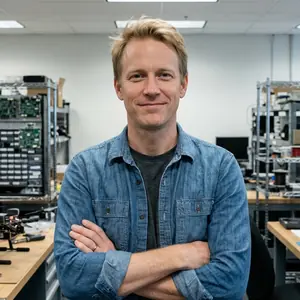
Silas Vance
Senior Systems Architect & Automation Lead
Silas Vance is a systems architect specializing in ambient computing and automated data pipelines.
Thursday Bram
Systems Architect
Thursday Bram focuses on the technical architecture of personal data pipelines and biometric signal extraction.

Kitty Ireland
Product Strategist
Kitty Ireland explores the intersection of narrative design and personal automation to drive habit change.

Linnea Sjöberg
Wearable Technology Strategist
Linnea Sjöberg is a strategist analyzing the intersection of wearable hardware and clinical health standards.

Teresa Demel
Clinical Research Coordinator
I document the real-world impact of quantified self interventions through detailed longitudinal case studies.
Silas and Thursday tend to think in pipelines: what gets captured, where it goes, how it is transformed, and what breaks when a platform changes its export format. Kitty looks at whether those systems actually support behavior, not just measurement. Linnea brings pressure from the wearable and clinical standards side, where claims need to be handled carefully. Teresa keeps the work grounded in longitudinal detail, because one good week of data rarely tells the full story.
How Do We Ensure Data Accuracy and Integrity?
We start by asking what the data is supposed to do.
A step count used for a loose habit cue does not need the same scrutiny as a heart-rate-derived recovery signal. A home automation trigger needs different checks than a month-long quantified self journal. The method follows the risk of the decision.
Our working checks
- Separate raw signals from interpreted scores whenever the platform allows it.
- Compare device claims against the practical limits of sensor placement, battery design, and sampling behavior.
- Look for export paths before recommending a tool for serious lifelogging.
- Document context that changes interpretation, such as travel, illness, shift work, device swaps, or changed routines.
- Treat automation as reversible by default, especially when it affects sleep, health routines, or privacy.
There are limits here. Consumer lifelogging tools often hide parts of their processing, so our conclusions stay tied to observable behavior, available exports, and documented use cases.
That is why Saga’s team is deliberately mixed. We need hardware skepticism, systems thinking, product judgment, wearable strategy, and case-study discipline in the same room. Without that blend, context-aware technology becomes either too technical to use or too simplified to trust.
If you want to understand how we frame the larger mission, visit About Saga. For questions about our editorial work or collaboration boundaries, use Contact Us.