What's Inside
- What the Quantified Self means before you buy a device
- How to build a clean personal baseline
- Which beginner tools reduce logging friction
- Why numbers need lived context
- How dashboards reveal useful patterns
- Where self-quantification can mislead you
- How context-aware archives may evolve
What Is the Quantified Self and Why Should You Track Data?
Start with the method, not the wristband.
The Quantified Self movement, co-founded by Gary Wolf, is best understood as a self-knowledge practice built around personal data collection. It is not the same as chasing a higher score in an app. The useful question is smaller and sharper: what can I learn about my own behavior if I observe it with a little discipline?
Lifelogging sits inside that practice. It means recording daily life through both passive capture and active notes. Passive capture might be location, steps, sleep timing, or computer use collected in the background. Active logging is the short evening note that explains the day: stress, meals, symptoms, travel, conflict, late caffeine, or anything else a sensor cannot infer reliably.
The n of 1 mindset
A beginner does not need a clinical protocol. A practical n of 1 setup can begin with one daily outcome, one suspected influence, and one context field tracked for about 14-21 consecutive days. That window is long enough to include two full weekday and weekend cycles, which matters more than it sounds.
Main Point: You are both researcher and subject. Treat that as a strength, but keep the question narrow enough that your future self can actually interpret the record.
How Do You Establish a Baseline for Personal Analytics?
A baseline is the measurement of ordinary life before you introduce a new variable. It is the unglamorous part of self-tracking, and it is usually where the useful work begins.
For a first baseline, track 14-28 days without planned changes to caffeine timing, supplements, exercise load, sleep schedule, or meditation practice. If life interrupts the plan, do not throw away the period. Mark the disruption as a context tag and keep the schema stable.
Separate numbers from context
Quantitative data gives you measurements: step count, sleep duration, resting pulse, screen time. Qualitative data gives you interpretation: mood label, stress trigger, pain location, social context. A minimal baseline table only needs 2-4 quantitative fields and 1-3 qualitative fields.
Robin Barooah's 2008 stress-and-meditation tracking remains a useful historical anchor because it shows a pattern that still works. Begin with simple daily entries. Keep the fields consistent. Let meaning emerge after repeated observations instead of trying to model your whole life on day one.
21-Day Starter Baseline Checklist
- Write one question in plain language, such as: what makes my sleep feel worse on workdays?
- Choose one primary outcome metric, such as sleep duration, mood score, focus blocks, pain level, or step count.
- Choose one suspected influence, such as late caffeine, commute stress, exercise load, screen time, or heavy meals.
- Add one context field so the number does not stand alone.
- Record the same fields daily for 14-21 days before making a deliberate change.
Which Devices and Apps Are Best for Lifelogging Beginners?
Tool choice should follow capture friction and exportability. Novelty wears off quickly; a low-friction log survives a tired Tuesday.
Passive wearables
Passive wrist or arm sensors work best for signals that benefit from continuous collection. Devices such as the Jawbone UP24, Fitbit, and BodyMedia FIT belong in this category. BodyMedia FIT is especially notable because it calculates calorie burn through multiple sensors rather than relying on movement alone.
These devices are useful for steps, sleep timing, movement intensity, skin temperature, heat flux, and galvanic skin response. They are less useful when the key variable is a feeling, a decision, or a social situation.
Active and specialized logs
RescueTime can help with computer usage by recording foreground applications and website changes. Daily summaries are helpful, but raw session blocks are better for spotting distraction loops. For computer behavior, a capture interval somewhere around 5-60 seconds is usually enough to reveal patterns without requiring manual notes all day.
Saga, the lifelogging application, fits the action-monitoring side of the field. MoodScope, founded by Jon Cousins, sits closer to active mood tracking. A beginner mood log should avoid constant prompting; 2-4 check-ins per day can distinguish morning, workday, evening, and pre-sleep states without turning the log into another stressor.
Visual lifelogging is a different commitment. Wearable cameras such as Memoto and Looxcie often capture still images every 30-60 seconds, enough to reconstruct travel, meals, meetings, and object interactions without full-day video. Trōv extends the idea into possessions, inventory, and purchase history.
Expert Tip: Before choosing a tool, check whether it exports timestamps and raw or near-raw records. A beautiful app with locked summaries can become a dead end.
Why Is Quantitative Health Data Not Enough on Its Own?
A step count can look like improvement while hiding a week of poor sleep, illness, or pain. The tracker records movement; it does not know why the movement happened or what it cost.
That is the central weakness of raw numbers. Pedometer steps, sleep scores, and calorie estimates become interpretable only when cross-referenced with context. For each daily numerical row, add 3-5 controlled tags such as sick, travel, heavy meal, conflict, late caffeine, pain, outdoor day, or social evening. Controlled tags are easier to compare than long free-text notes.
What the community learned by combining data sets
Quantified Self Europe conference examples often return to the same lesson: the explanatory variable is frequently outside the health metric. Jewel Loree compared listening behavior with mood. Adrienne Andrew Slaughter combined commute experience with diet records. Neither case treats the sensor as the whole story.
The timing matters too. A useful cross-reference window is same-day plus the next 1-2 days, because sleep loss, alcohol, intense exercise, and emotional stress often show their effects after a lag. This is where tidy daily charts can mislead; the body does not always report consequences before midnight.
Caution: Mood tracking can degrade into noise when the rating scale changes midstream, when only bad days get logged, or when free-text entries cannot be compared later.
How Can the Right Dashboard Transform Your Personal Data?
A dashboard should come after stable data, not before it. Visualization rewards consistency.
The first useful workflow is plain: export raw data once every 7 days during the first month, keep the original files unchanged, and create a separate cleaned file. That gives you a trail back to the source when a timestamp looks wrong or an app changes its export format.
From CSV to pattern recognition
Normalize timestamps before graphing. Use one local time zone, add a wake/sleep boundary if relevant, and bin high-frequency data into 15, 30, or 60 minute blocks depending on how quickly the behavior changes. Shift workers, caregivers, night-owl programmers, and frequent travelers often need wake-to-wake days instead of midnight-to-midnight charts.
A beginner dashboard needs only three views at first: a timeline, a 7-day rolling median, and a scatterplot with optional 0-day, 1-day, and 2-day lag comparisons. That is enough to notice serendipity, the accidental but valuable discovery that appears when unrelated records sit on the same timeline.
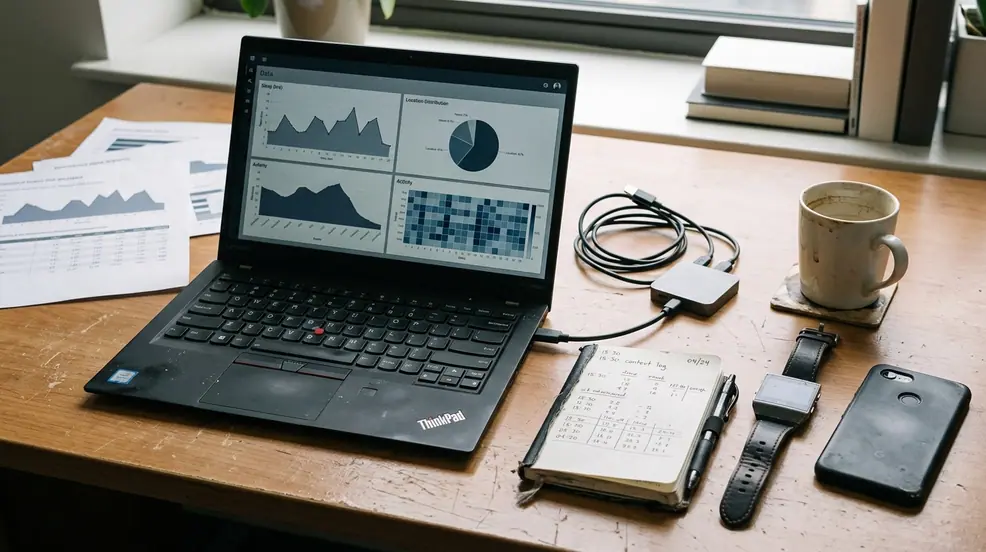
Tableau and Piktochart can help turn CSV files into readable visuals without much setup. For sensor-heavy projects, Freeboard and dweet.io, developed by Bug Labs for the Internet of Things, can accept key-value readings every 10-60 seconds. That pace is enough for room sensors, simple wearables, and home automation context streams.
What Are the Risks and Limitations of Self-Quantification?
Algorithms are measurement instruments with built-in value judgments. They decide what counts as a day, which movement matters, when sleep begins, and what data you are allowed to export.
Common hidden assumptions include midnight-to-midnight day boundaries, proprietary sleep-stage labels, movement filters that ignore cycling or load-bearing work, and calorie estimates inferred from incomplete body context. These assumptions are not always wrong. They are just not neutral.
Close data, open data, and ownership
The tension between close data and open data appears when a person can view personal insights in an app but cannot retrieve raw samples, complete timestamps, or sensor-level records through an export or API. Groups such as the German Cyborg Association have drawn attention to data ownership because the issue becomes personal quickly: a device may sit on the body, but the record may live somewhere else.
Certain providers expose only daily summaries or recent-history exports. More useful raw data may be inaccessible, delayed, downsampled, or locked behind account and device restrictions. The cochlear implant example makes this concrete: a person may rely on a device embedded in the body while still lacking direct access to the operational data used by clinicians or manufacturers.
Dick Talens has also criticized the movement's tendency to confuse tracking with improvement. That criticism is worth keeping close. Personal device logs should not be treated as medical evidence for medication changes, diagnosis, implant settings, or treatment decisions without clinician-grade validation.
Where Is the Future of Context-Aware Technology Heading?
The beginner workflow scales into something much larger: a searchable personal memory system.
Extreme lifelogging setups may combine wearable images, GPS traces, calendar entries, messages, biometrics, purchases, and environmental sensors into a 24-hour context stream. Chris Dancy is often cited as a prominent self-quantifier in this territory. Cathal Gurrin's 7+ years of continuous wearable camera data points in the same direction, but with a researcher's emphasis on retrieval.
The search engine of the self
Gurrin's phrase, the search engine of the self, captures the destination better than most hardware pitches. The goal is not merely to record life. It is to index it by time, place, people, objects, and remembered intent so that a person can ask better questions later.
Storage becomes part of the design. Depending on interval, resolution, and compression, a still-image archive can plausibly add somewhere around 8-90 GB per month before deduplication or downsampling. That is manageable for a project, but not trivial for a life.
For most beginners, the path can stay modest: 14-28 days for a baseline, another 21-42 days after adding one habit or intervention, then a monthly review to decide whether the metric still answers the original question. If it does, keep it. If it does not, retire it without guilt.
Main Point: The best personal analytics system is not the one that tracks everything. It is the one that preserves enough context for the next good question.