The Evolution of the Quantified Self
The quantified-self movement began as a voluntary habit. People logged steps, sleep intervals, meals, mood, and location, then synced everything later and read the summary as a record of how the day went. Chris Dancy pushed this further than most, treating his own life as a continuous data feed and arguing that what gets measured gets understood.
There is a philosophical edge here that George Berkeley named centuries before any accelerometer existed: esse est percipi, to be is to be perceived. Ambient sensing inverts the idea slightly. The wearer is no longer the one doing the perceiving; the sensor perceives the wearer, continuously, whether or not the wearer pays attention.
Early consumer hardware in the 2009 to 2014 window made this concrete. Clip-on and armband devices from Body Media, the wrist-and-pocket Fitbit line, and the Jawbone UP band all leaned on motion data. They counted steps, estimated calories, and tagged sleep, but they interpreted very little in real time.
The interesting shift is from accelerometer-led summaries to body-adjacent sensors that read heart rhythm, skin temperature, EEG signals, posture, or motion state during the activity. A sleep score stops being a trophy and becomes a prompt. Over a week to three weeks of observation, the number matters less than the adjustment it triggers: caffeine timing, exercise windows, screen exposure, or a more regular bedtime.
Criteria for Selection: Moving Past the Wrist
This list treats the wrist as a baseline, not a subject. The 2013 to 2015 Android-wearable wave set the comparison point: glanceable notifications, step counts, gyroscopes, heart-rate estimates on later models, and phone-tethered apps. Devices like the Samsung Gear Live, the LG G Watch, and the Moto 360 defined what a wrist could do, while standalone units such as the Neptune Pine tested whether moving a phone interface onto the arm added anything.
It mostly did not. Relocating a screen is not the same as sensing something new.
So the inclusion threshold here is twofold: non-wrist placement plus at least one context-specific data stream. EEG at the forehead. Infant pulse at the foot. Canine movement read against breed and size. Crash dynamics measured at the neck and head. Interpersonal signals captured inside an isolated crew. Each placement unlocks a reading that a generic wrist tracker cannot easily capture, or feeds an API that lets the device join a larger data graph.
One caveat shapes this entire selection: it favors biometric and context-aware novelty over mass-market availability. A device can matter here even if it was expensive, region-limited, or short-lived.
1. Head-Mounted Displays and Brain Wave Sensors
Two head-worn categories sit close to perception, and that proximity is the reason to group them. One captures what the user sees or does; the other tries to quantify mental state.
The Muse headband by Interaxon belongs to the second group. Like other consumer meditation headbands of the mid-2010s, it used dry forehead and ear-contact electrodes to estimate EEG bands tied to calmness or focus, then translated that stream into audio feedback across sessions of roughly 3 to 20 minutes. The translation is elegant when conditions cooperate.
Caution: A head-worn EEG meditation sensor can produce plausible relaxation feedback during a quiet seated session yet degrade sharply when the wearer talks, clenches the jaw, walks, or loses good electrode contact. The feedback is only as honest as the contact quality.
Optical headsets and context capture
Google Glass demonstrated the first category. First-person photos, voice commands, eye-level notifications, and experimental gesture shortcuts turned the head into a capture point. The Winky app added a small flourish: a wink triggered an image, removing even the hand from the act of photography.
From notification to medical prompt
The most serious head-mounted experiment was clinical. CPRGLASS, developed by Dr. Christian Assad, paired visual prompting with compression timing. The operational target is a compression rhythm of 100 to 120 per minute, with feedback aimed at depth, pace, and reducing interruptions. The familiar trick of using Stayin' Alive as a metronome works because the song's tempo sits close to that recommended cadence, making it a memorable timing aid rather than a sensor in its own right.
2. Biometric Monitoring for Animals and Infants
Animals and infants form a distinct category for one reason: the wearer cannot reliably self-report symptoms, fatigue, stress, or discomfort. The sensor stops being a feedback loop and becomes a proxy voice for someone who has none.
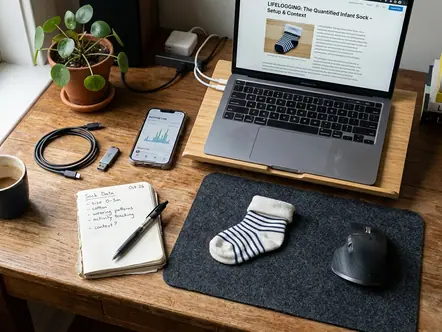
Infant foot-worn monitors, the smart sock among them, are chosen for pulse, oxygenation-adjacent signals, skin temperature, and sleep-state inference. The foot holds a soft sensor without chest straps or adhesive patches during ordinary crib sleep. The practical window is overnight, roughly 6 to 12 hours, where false alarms, sock fit, motion artifacts, and cold extremities matter far more than any daytime dashboard detail.
FitBark sits in a different problem space. A canine activity tracker only gains meaning after size, breed tendency, and age enter the interpretation. A 20-minute burst of hard movement reads very differently for a young working dog than for an older toy breed.
Caution: A dog tracker that looks useful on a high-energy breed can mislead on a short-legged or older dog unless the benchmark accounts for gait, body size, age, and medical limitations.
horseAlarm narrows the focus even further. It watches pregnant mares for pre-labor signals such as repeated lying down, sweating, restlessness, and posture changes during the final nights before birth. The output is not a fitness graph; it is a timely alert in a window where minutes count.
3. Unconventional Safety and Conceptual Wearables
Airbag collars, sensor wigs, and motorized footwear share one design move. The wearable stops imitating a miniature phone and becomes a body-positioned actuator or sensor.
The Hövding bicycle airbag is the clearest case. A neck-worn collar monitors crash-like motion and deploys around the head and neck after a trigger. The hard part lives in the fraction of a second between loss of control and impact, where the system must separate a fall's rotational acceleration from ordinary riding: shoulder checks, curb bumps, braking, dismounting.
Main Point: A crash-detection wearable must survive edge cases such as a dropped device, abrupt braking, potholes, or playful movement. False positives are not merely annoying when the deployment is physical.
The conceptual end of the spectrum is stranger and arguably more revealing. The SmartWig explored touch, orientation, vibration, and location cues, hiding body-worn computing inside an ordinary social object rather than announcing it as a gadget. Vacuum shoes belong to the same imaginative lineage, treating walking itself as a trigger for cleaning, sensing, or surface interaction.
Both point past the screen entirely. They are the Internet of Things worn on the body, where the device acts on the world instead of reporting to a display.
4. Psychological Sensors for Extreme Environments
Astronaut-oriented psychological sensing is a research category, not a consumer one. The reasoning starts with the environment: small crews, delayed help, repetitive routines, and no easy exit. University-led, federally supported work in the 2010s, including research funded by NASA and conducted at Michigan State University, explored wearable and ambient sensing for crew interaction.
The signals are social and subtle. Speech patterns, proximity, movement, conversational turn-taking, and stress-linked behavioral changes all feed the model. The deployment horizon is not a gym session but multi-week to multi-month isolation, where small shifts in withdrawal, agitation, sleep timing, or communication rhythm can become operationally meaningful long before anyone names a problem aloud.
The intended output is self-regulation. Real-time feedback nudges a crew member toward a breathing exercise, a de-escalation, a schedule adjustment, or a private moment of reflection before tension hardens into a mission risk.
No single metric carries this weight. Voice cadence, physical proximity, sleep regularity, and activity level together describe a crew far better than any one stream alone, which is exactly why these systems lean on fusion rather than a hero sensor.
The Future: The Body as a Platform
Step back, and the body becomes the integration layer. Individual devices grow less interesting as objects and more important as feeds. A mature lifelogging stack can combine minute-level activity data, nightly sleep windows, location history, purchase traces, calendar context, social graph signals, and public-record identity fragments into one behavioral profile.
That aggregation is where the stakes climb. Third-party brokers and profile aggregators such as Spokeo can connect wearable-derived inferences to non-biometric records: addresses, relatives, contact details, interests, demographic signals. The wearable maker never has to publish a raw sensor file for those inferences to travel.
Expert Tip: When evaluating any non-wrist device, ask not only what it senses but where that signal can end up. The placement on the body is half the story; the data graph downstream is the other half.

The realistic future is not one universal gadget. It is a mesh of narrow, persistent sensors worn on the head, foot, torso, collar, clothing, an animal harness, an infant sock, or a vehicle-linked accessory. Each contributes a thin but continuous signal, and the aggregate is the product.
The old rocketpack comparison fits well here. Both biometric wearables and personal flight were imagined as extensions of the body. The difference is in the arrival. Rocketpacks promised drama and never came; bio-based tech slipped in quietly through socks, collars, bands, helmets, glasses, and fabric, ubiquitous precisely because no one announced it.