Introduction
The Narrative Clip makes sense only as a product of its moment. Strip away the gadget nostalgia and what remains is a wager about lifelogging: that passive capture, searchable memory, and an automatically accumulating visual diary were worth wearing on your chest every waking hour.
The mechanism was deliberately simple. A small camera took one image every 30 seconds — roughly 120 frames per hour before deletion, upload failure, or a dead battery entered the equation. The user did nothing. The device just watched outward and recorded.
That bargain had a clear shape. You accepted low-friction, chest-level images in exchange for never pulling out a phone during a meal, a walk, a commute, a conference, or a family dinner. For a narrow window, mainly 2012 to 2016, that trade looked plausible. Dedicated lifelogging wearables still had room to exist before phone cameras, cloud photo search, and early smart-glasses prototypes absorbed the category.
This is the story of a fascinating experiment that ultimately lost to two forces it could not engineer around: the physics of small sensors and the social rules of shared rooms.
The Promise of Frictionless Lifelogging
The original pitch was about authenticity. Most photos are performances; people stop, pose, and frame. The Clip promised the opposite — unposed transitions captured while you lived behind no screen at all.
The crowdfunding result gave that vision a number. The campaign raised somewhere around $550,000 from roughly 2,900 backers. That figure validated genuine early-adopter demand, but it is worth reading carefully. A few thousand backers signal a specialist quantified-self audience, not a mass camera market ready to change its habits.
The capture math explains both the appeal and the eventual strain. At the default 30-second interval, a wearer generated about 960 images across an 8-hour day, or 1,920 across a 16-hour waking day. The model rewarded the in-between moments: walking between rooms, commuting, desk work, meals, and chance encounters.
What it could not do was compose. With no viewfinder, the wearer never framed a shot deliberately. That was the point — and, in hindsight, the seed of the problem.
Hardware and User Experience Review
Judge the Clip by the daily loop it asked of you: attach it securely, keep it facing outward, survive changing light, remember to charge it, sync the backlog, and then inspect whatever it captured. Each step was small. Together they added up.
The Physical Object
The original square unit measured roughly 36 mm by 36 mm by 9 mm and weighed around 20 grams. That made it genuinely unobtrusive on a shirt, a jacket lapel, a backpack strap, or a lanyard. It did not feel like a camera, which was the entire design intent.
Mounting position decided everything. Clipped too low on a loose shirt, it produced table edges, torsos, ceiling angles, and motion blur. Anchored to a firmer jacket or a strap, it delivered more stable, first-person-adjacent scenes.
The Technical Ceiling
The original model paired a 5-megapixel camera with 8 GB of onboard storage. For a passive diary camera in 2013 and 2014, those specs were defensible. Beside phones that were rapidly improving exposure, autofocus, and low-light handling, they aged quickly.
The hardware felt far better in bright outdoor travel or conference settings than in dim restaurants, evening homes, bars, or fast-moving indoor scenes.
The Interface Gap
A double-tap let users manually mark a moment. Useful in theory, but it did not solve framing — there was still no live preview, so you often learned only the next day whether the shot was usable. And the next day was where the work lived. A full day of capture leaned on companion software and sync behavior; if charging, transfer, or cloud processing stalled, your diary became tomorrow's chore.
The Privacy Problem and Social Friction
Technical recording and social permission are two different things, and the Clip failed at the room level as much as the sensor level. A device can be legal, tiny, and silent while still changing how a room behaves.
The 30-second interval meant bystanders were not filmed continuously. They were, however, photographed repeatedly across a conversation, a meeting, a dinner, or a class. Unlike a phone, which is usually raised before it captures, the Clip sat active at chest height for 30 to 120 minutes without drawing fresh attention each time. That made consent almost impossible to negotiate in real time.
The backlash echoed what contemporary smart-glasses prototypes hit in the 2013 to 2015 period. The objection was never just image quality or battery life. It was the visible suggestion that ordinary spaces had quietly become recordable by default.
Certain spaces produced the sharpest friction:
- Private homes, where guests expect contextual control
- Workplaces and medical waiting rooms
- Classrooms and gyms
- Bars and restaurants
On a public street, a passerby has fewer expectations. Inside a friend's kitchen, those expectations are reasonable, and a chest-mounted camera ignores them.
Data Overload and the Curation Dilemma
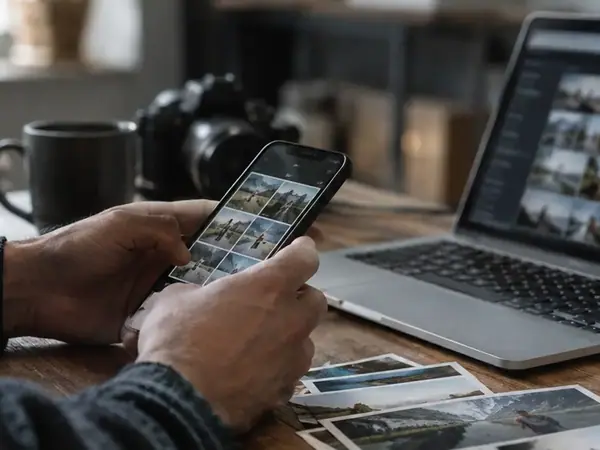
The image pile was the central user-experience failure. Automatic capture does not remove labor; it relocates it from the moment of photography to the moment of review. You no longer decide what to shoot. You decide, later, what to keep.
Consider the volume. A 12-hour wearing day at one image every 30 seconds yields about 1,440 images before you remove duplicates, pocket shots, dark frames, and accidental angles. Stretch that to a five-day workweek of 10-hour sessions and you reach roughly 6,000 images. That is no longer a pleasant diary habit. It is recurring maintenance.
The software tried to curate algorithmically, picking the "best" frames. The trouble is that ordinary life produced the hardest cases — near-duplicates, blurred transitions, lighting failures, accidental captures. Landmark events are easy to detect. A Tuesday is not.
Main Point: The most common low-value outputs were desk shots, partial faces, steering wheels, keyboards, plates of food, elevator interiors, sidewalks, and chest-level fragments of conversations. The diary filled with documentation of posture rather than memory.
Two failure cases capture it well. A dim dinner from 19:30 to 21:00 could generate hundreds of blurred, chest-level, socially awkward images while adding almost nothing of value. A full workday with the Clip facing a keyboard or monitor produced more evidence of routine than of life history.
The exceptions were instructive. Outdoor travel days, walking tours, conferences, and maker gatherings were far more forgiving — stronger light, higher novelty, and bystanders already accustomed to visible gadgets.
The Market Shift and Company Collapse
The collapse came from replacement pressure, not a single fatal flaw. Several adjacent technologies improved at once and squeezed the category from every side.
From 2014 to 2016, phone cameras gained faster lock-screen launch, better low-light exposure, burst capture, and automatic backup. Many users could now capture meaningful moments deliberately, without strapping on a second device for the entire day. The core justification for passive capture weakened.
Action cameras took the adjacent lane. With wide-angle video, mounts, water resistance, and sport-specific durability, they were easy to justify for cycling, skiing, diving, driving, and travel. They solved a problem people clearly had.
Meanwhile the maker carried an awkward burden. It had to manufacture small physical units, support companion apps, process large image libraries, and maintain cloud infrastructure — all for a niche user base. That is a hardware-and-service combination that punishes small audiences.
By the 2016 to 2017 shutdown window, the category's weakness was obvious. The Clip was not merely competing with cameras. It was competing with phones, cloud photo timelines, smart wearables, and shifting privacy expectations, all at the same time.
Conclusion: The Legacy of the Narrative Clip
The Narrative Clip failed as a consumer habit, not as an idea. Stack the reasons and the picture is coherent: hardware-limited images, battery and syncing chores, social discomfort, and a review burden that scaled from hundreds to thousands of images per day. No single item sank it. The accumulation did.
The idea, though, survived. Passive capture, contextual memory, and personal data trails all live on in later context-aware systems — ones that emphasize selective capture, visible recording indicators, voice triggers, local processing, automatic memory surfacing, and tighter integration with phone photo libraries. Much of what the Clip attempted clumsily is now standard, just distributed across better-designed hardware.
Expert Tip: The enduring lesson is operational. Lifelogging works when capture, consent, storage, search, and deletion are designed as one system. It breaks when capture is automated but every downstream decision is dumped back on the user.
One honest qualification belongs here. This is a retrospective read of a product that lived in a specific four-year window, and the social tolerances around wearable cameras have kept shifting since; conclusions that feel settled today were genuinely contested then. The quantified self never went away. The hardware simply learned that recording the world is the easy part — living with what you recorded is the rest.