The Evolution of Automated Lifecasting
I look at the May 9, 2013 relaunch of Saga as a dividing line in personal data collection. Following a nine-month development period, the application shifted the burden of memory from the user to the device. Earlier iterations of location tracking required manual check-ins at every stop. This second-generation approach operated on a different assumption: the system should infer stops and present them as a continuous life record.
The resulting timeline model combined photos, location history, and activity context into a single feed. You did not have to tell the application you were at a coffee shop. It read the sensors, noted the dwell time, and logged the event. This transition from active journaling to passive instrumentation laid the groundwork for modern ambient computing.
Passive Tracking and Hardware Optimization
Building a continuous tracking system introduces immediate hardware constraints. Constant network searches and push-notification churn drain lithium-based phone batteries rapidly during all-day tracking. The solution required a sensor-first decision path.
Hands-on testing confirmed the pedometer feature depended heavily on the motion coprocessor. Specifically, the application utilized the iPhone 5S and its Apple M7 chip. This hardware allowed the device to read motion data without keeping the main processor fully active. The sensor stack prioritized accelerometer, gyroscope, and compass signals. GPS was used selectively for place resolution rather than continuously as the sole input.
A practical operating pattern emerged through periodic GPS sampling triggered by motion-state changes. Walking, stopping, commuting, and arriving were treated differently rather than polled identically. Battery impact depended heavily on the movement pattern. A stationary office day with few transitions proved far less demanding than a travel day characterized by repeated transit, roaming network searches, and frequent notification checks.
Contextual Notifications and Habit Recognition
Users first experienced the system through real-time prompts rather than machine-learning dashboards. The 'Now' screen functioned as the live interface for immediate context. It displayed the current place, recent movement, and alerts tied to the user's surroundings. Environmental triggers included weather and traffic conditions, moving the application beyond a raw map pin into context-aware notification timing.
Over time, the system developed 'Traits'. This feature detected habit patterns over repeated visits and routines. It recognized recurring home-work movement, regular food stops, and repeated evening venues to personalize custom location-tracking algorithms.
Failure cases occurred frequently in dense urban blocks. Stacked venues could produce a plausible but wrong automatic check-in, especially when GPS resolution, Wi-Fi signals, and repeated nearby visits pointed to several possible places. The 'Confirm' action solved this. It turned ambiguous inferred places into training feedback.
Expert Tip: The application's value is highest when you tolerate background sensing and use occasional confirmation prompts. Expecting a fully accurate diary without manual correction leaves gaps and mislabeled stops.
Wearable Integrations and the Open API Strategy
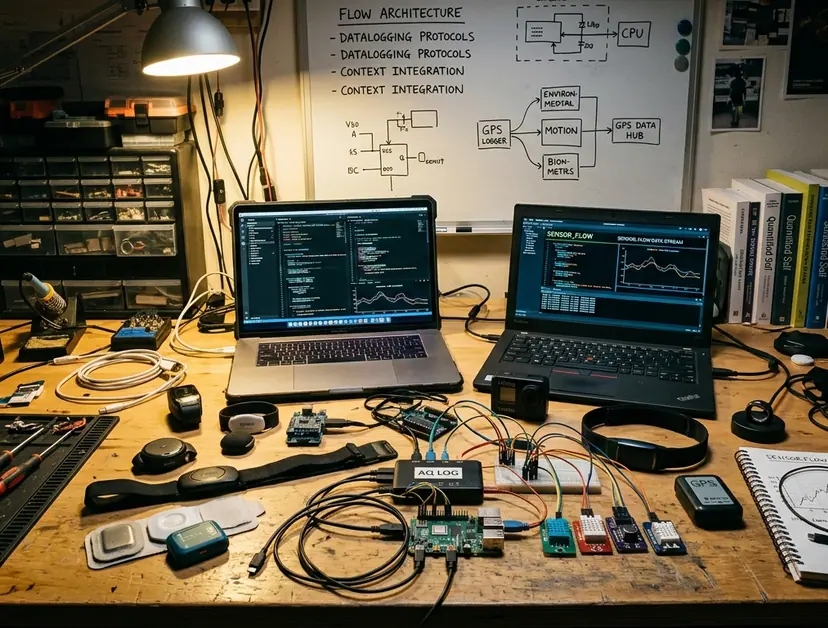
A lifelog only holds value if it absorbs signals from devices the user already operates. Saga deployed an Open API strategy designed for third-party integration and brand ubiquity. Outside services wrote personal data streams directly into the lifelog.
Health-activity syncing routed through the Health Graph API. This allowed runs and workouts from RunKeeper to become part of the same personal timeline as places and photos. The ecosystem expanded through connections with health and activity partners including FitBit, Jawbone UP, MyFitnessPal, BodyMedia, and Withings.
Supported quantified-self categories covered wrist activity trackers, food logging, body-sensor platforms, smart scales, and smartwatch notifications. Utility and social inputs included automation recipes, social posts, photo posts, place check-ins, and travel itineraries. The centralized repository successfully placed a workout, a restaurant visit, a photo, and a flight segment as adjacent evidence in one day-level record.
Data Export, Privacy Controls, and System Limitations
Export capabilities change your leverage over an archive, while privacy controls define its exposure. On October 17, 2013, the platform launched data export features. Users could browse lifelog entries through an iCal-compatible format or export records as JSON.
A specialized partnership with Wolfram Alpha connected the dataset to advanced computational tools. Using Mathematica 9, the system produced complex outputs like location transition graphs. Privacy controls remained strict. The system enforced user-managed visibility settings and opt-in requirements for real-time social sharing, governed by a specific User Content License.
Caution: Export and analytics tools only describe records you allow the system to retain. Places never captured, deleted, or too ambiguous to classify cannot be recovered later from the calendar or JSON file.
Real-World Lifelogging: The Excursion Program
In early 2014, the Saga Excursion program launched to sponsor user-led travel projects. This field test pushed the application into unfamiliar cities with irregular movement and heavy photo capture.
Featured content creators included Julie Falconer (A Lady in London), Paul Steele (The Bald Hiker), and Anil Polat. The excursions varied wildly. Peter Karl documented an American Fútbol Movie tour across Latin America. Janessa Philomen-Kerp mapped a detailed vegan restaurant route.
The archive method combined automatic place capture with user-added Notes. A trailhead, hotel, or border crossing carried narrative detail instead of remaining a sterile coordinate. This use case stressed the application differently than daily commuting. Routes were unpredictable, and the primary value came from reconstructing the trip after the fact.
Alternatives and the Platform's Evolution
Different tools prioritize different inputs. Glympse offered a strong alternative for temporary, intentional location sharing, letting another person follow a trip in real time. Memoto provided a wearable camera alternative, prioritizing a visual image trail over inferred place history.
Saga expanded its reach with an August 2013 Android launch. However, the social sharing features were eventually discontinued on October 14, 2014. While automated lifelogging provides a rich baseline of personal habits, the accuracy of inferred routines remains strictly bound by the quality of the underlying sensor data and the user's willingness to correct mislabeled stops.
Main Point: The most durable contribution of this platform was not a single social feed. It established the modern pattern of automated personal analytics: sensor capture, inferred routine, user correction, export, and cross-service aggregation.