There is a particular kind of person who tries to log their life as it happens, and there is a predictable moment where that person stops. Usually it arrives around day nine, mid-conversation, when they realize they have been composing the entry instead of listening.
Manual Logging Taxes the Very Moment It Records
Recording an experience while it unfolds forces a stream of small decisions: when to stop, what deserves capture, how to phrase it. Each decision is cheap. Stacked across a waking day, they are expensive enough to change the thing being recorded.
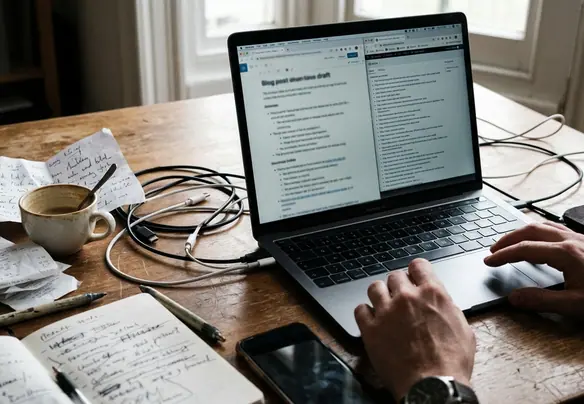
Meanwhile, an unremarkable phone has already produced a dense, unbiased record of the same day. Navigation logged the route. The card terminal logged the sandwich. The camera roll logged the light on the bridge at 18:42, with coordinates attached. Browsing left a trail of what held attention and for how long. None of it required a decision, and none of it interrupted anything.
Retrospective reconstruction takes that position seriously. The diary is assembled afterward, from timestamps generated independently by movement, purchases, photography, and conversation. The target is one calendar day, 00:00:00 through 23:59:59 in the person's local time zone, rebuilt the next morning in under ten minutes. Anything that regularly exceeds fifteen minutes is a signal that collection or normalization still needs automating.
Pulling Yesterday's Exhaust Into One Dated Folder
Collection runs from the hardest evidence toward the softest. Transactions and photographs go first, because each one nails a time to a place or an object. Messages, browser history, and location samples come second, filling the intervals the anchors leave open.
Build a single dated intake folder holding: location exports, receipt emails or a transaction CSV, a browser-history export, message timestamps, and the day's original image files. Preserve the originals untouched and parse copies. Native exports beat polished dashboards here, including the ones inside lifelogging applications such as Saga, because CSV, JSON, database, and image files can be read, diffed, and re-parsed years later without asking anyone's permission.
From each photograph, pull DateTimeOriginal, OffsetTimeOriginal, GPSDateStamp, GPSTimeStamp, latitude, longitude, and the original filename. Camera clocks typically write YYYY:MM:DD HH:MM:SS; GPS time arrives in UTC. The two disagree constantly, which is exactly why both get stored.
Grab the previous 24 hours plus a two-hour buffer on each side. Late-night activity and time-zone conversion both like to shove records across midnight, and a buffer is cheaper than a forensic hunt for a vanished evening.
The Braid Test
A reconstructed hour is trustworthy when three independent sources agree on it: a receipt, a photo, and a message. Where the braid frays to a single thread, mark the hour lower-confidence and move on.
Two Time Fields, One Chronological Spine
Every harvested record gets converted into two fields. One is an immutable UTC instant stored as YYYY-MM-DDTHH:MM:SSZ. The other is the source-local value with its offset intact, such as YYYY-MM-DDTHH:MM:SS-04:00. The ISO 8601 standard earns its place here for a boring reason: the offset is explicit, and lexicographic sorting stays chronological.
Epoch values follow a simple rule. Ten digits are seconds. Thirteen digits are milliseconds. Guessing wrong moves an event by decades, so it is worth checking the digit count before parsing.
Timezone-free photo timestamps are the recurring headache, and the fix is procedural. If two independent anchors bracket the photograph within thirty minutes and both carry the same offset, apply that offset to the image and preserve a flag such as timezone_inferred=true. The inference stays visible, which means a future reader can revisit it instead of inheriting a quiet fabrication.
Bulk exports are strongly preferred to repeated API calls. When an interface has to be queried, process bounded batches, persist the last successful cursor, and retry after delays of one, two, and four seconds rather than throwing away the day and starting over.
Worth saying plainly: the finished sequence is a high-accuracy proxy, not down-to-the-second ground truth. Outdoor phone fixes wander by roughly 5 to 30 metres, indoor fixes drift considerably farther, device clocks get misconfigured, and rate-limited services silently omit samples. The timeline is good enough to reason about behavior and not good enough to litigate.
Reading the Quiet Stretches
Sort the normalized records, then compare each adjacent pair and attach the elapsed interval to the earlier one as minutes_since_previous. That single derived field does most of the auditing work.
An interval graduates into a silent void only when it crosses a threshold and contains no location, transaction, browser, photo, or message evidence whatsoever. Flag waking intervals longer than 45 minutes and overnight intervals longer than 6 hours, then revisit both numbers after seven consecutive reconstructed days, once the shape of an ordinary week is visible.
Render the day as a sorted table with timestamp, source, summary, confidence, and minutes_since_previous, highlighting anything above the active threshold. For a faster visual pass, bucket events into 15-minute intervals; four consecutive empty waking buckets produce a review candidate.
The voids are evidence in their own right. A phone that stops generating exhaust for ninety minutes every Tuesday afternoon is describing a behavior — and the patterns people report from reconstructing their own weeks run in the same direction. Deep work, driving, a run without the watch, a conversation that held full attention. Absence of data is a reading, not a hole in the record.
Turning Anchors Into Sentences
Annotation starts only after the machine-derived order is stable. Reordering a day after it has been narrated invites the narration to bend the sequence.
Open the strongest anchor bordering a void — a lunch receipt followed twenty minutes later by a photograph, and write the smallest memory fragment that explains the interval. Keep each annotation to one or two sentences, roughly 8 to 30 words. If an interval fails to produce a reliable memory within sixty seconds, stop. The gap keeps its label and the reconstruction keeps its pace.
Separate observation from interpretation using confidence labels. A receipt timestamp is observed. Travel between two known locations is inferred. A remembered mood is recalled. A compact entry looks like this:
13:08–13:42 — walked from café to office; thinking through the afternoon presentation [inferred/recalled].
Brevity is the discipline that keeps the whole method alive. Long entries turn the morning review into an essay assignment, and essay assignments get skipped.
A Folder That Still Opens in 2040
The archive is built for durability and retrieval. One human-readable Markdown file per day, with an optional JSON sibling for scripts. Name files YYYY-MM-DD.md inside year and month directories — 2026/09/2026-09-13.md, so ordinary directory sorting produces chronology without any tooling at all.
Give every event the fields start, end, timezone, location, source, confidence, tags, and text, plus source_record_id whenever the originating export supplies one. Consistent field names are what makes a keyword search in 2040 return something useful.
This archive braids movement, spending, contacts, and private reflection into one object, which makes it far more sensitive than any of its inputs. Keep it local. Maintain two copies on separate encrypted devices, add a third encrypted offline copy something like every 7 to 14 days, and actually test restoring one daily file every 30 to 45 days, more or less. An untested backup is a rumor.
Ten Minutes, Coffee, Yesterday
Here is the recommendation, stated without hedging: stop logging your life as it happens. Capture nothing manually during the day except the occasional thought that would otherwise evaporate, and rebuild yesterday tomorrow morning at a fixed cue.
Run it on a timer. Two minutes to import the intake folder. Two minutes to normalize and sort. Three minutes to inspect flagged voids. Two minutes to annotate. One minute to save and back up. Do it somewhere around 8 to 14 hours after the day's final waking activity, ideally before new messages and browsing start generating a second day's evidence on top of the first.
When the timer ends with intervals still unresolved, mark them unknown and close the file. That rule is the whole safeguard: without it, retrospective reconstruction quietly mutates into the continuous logging obligation it was built to replace. Ten minutes, once, over coffee — and the day you actually lived stays intact.